
Duct sealing
Seal the leaks. Keep the air you paid for.
Duct sealing closes the openings in a duct system that let conditioned air escape before it reaches the rooms it was intended for. In Southeast Louisiana, those duct runs often sit in a hot, humid attic — which is exactly where losing conditioned air hurts the most.
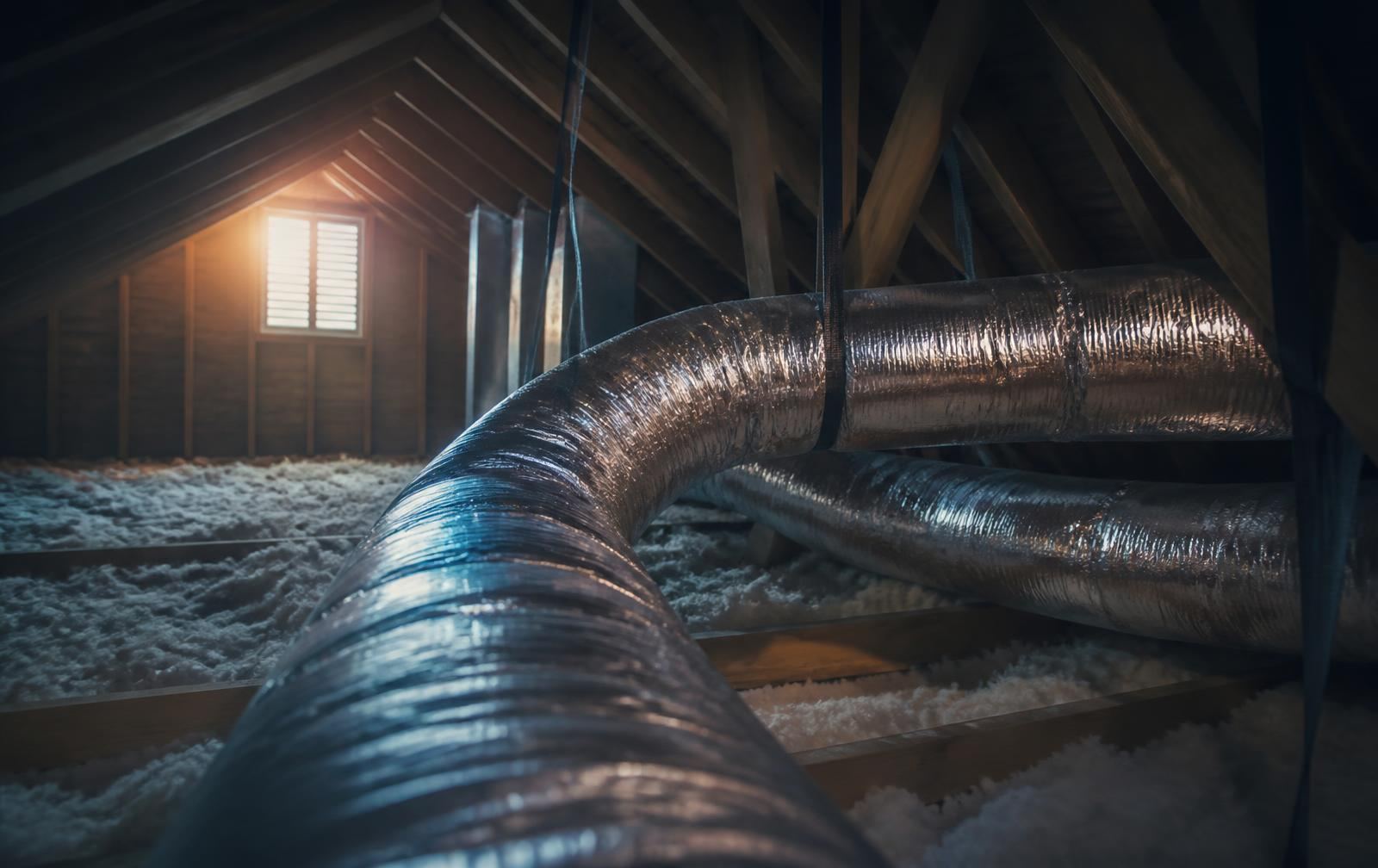
Where duct systems leak
Leaks are rarely in one dramatic place.
Duct leakage is usually the sum of many small openings spread across the system.
- Connections between duct sections and fittings
- Boots where ducts meet ceilings, floors and walls
- Plenum and air-handler connections
- Seams and joints that have loosened over time
- Damaged, disconnected or deteriorated sections
- Return-side openings pulling air from unconditioned space
What changes
Same equipment. More of the air actually arriving.
Sealing does not make an HVAC system bigger or newer. It reduces how much of its output is lost on the way to your rooms.
How we seal: from inside the ductwork
Our featured method is aerosol duct sealing. Registers are temporarily blocked, the duct system is pressurized, and a fine sealant mist is introduced inside the ducts. Air escaping through a leak carries the sealant to that opening and builds a seal across it from within — including joints buried in insulation, wall chases and other places a technician cannot reach by hand. The sealant collects at the gaps; it is not a coating applied over the whole duct interior, and it is not sprayed on the outside of the duct. Accessible connections, boots and plenum seams are also addressed manually where that is the better repair.
Leaky duct system
A horizontal attic unit feeds a sheet-metal plenum, then flex runs branch out to each room. Leakage is rarely one hole — air escapes at the plenum seams, at each takeoff collar and at the register boots.
Air lost at plenum seams, takeoff collars and boots
Sealed duct system
With the plenum seams, collars and boots sealed, more of the conditioned air travels the full run and arrives in the rooms you actually live in.
Air stays in the ducts and reaches every register
Closet unit, leaky chase
Common around here: the air handler sits in a closet and the supply runs straight up a wall chase into the attic. Every joint on that path — chase, ceiling penetration, plenum, boots — is a place air leaves.
Air lost in the chase, at the ceiling and at every boot
Closet unit, sealed chase
Sealed at the chase, the ceiling penetration, the plenum seams and each boot, the same system delivers the conditioned air into the rooms instead of the attic.
Air stays in the chase and reaches every ceiling register
What measurement actually tells us
A duct leakage test pressurises the duct system and measures how much air it takes to hold that pressure. The air that has to be continuously supplied is, in effect, the air the system is losing. That gives a number rather than an impression — and it is the same measurement we repeat after sealing, under the same conditions, so the two are comparable. Testing also distinguishes total leakage from leakage to the outside of the conditioned space, which matters because a leak into a hot attic costs you far more than a leak into a hallway soffit.
Measurement is also how we avoid selling work that will not help. If a system is already reasonably tight, the honest answer is that the comfort complaint has another cause — airflow design, insulation, equipment sizing or thermostat behaviour — and we would rather say that than seal a system that did not need it.
Aerosol sealing vs. manual sealing vs. duct replacement
- Aerosol sealing
- Best suited to systems with many small-to-moderate leaks spread across joints, seams and boots — especially where those connections are buried in insulation, wall chases or framing. It works from inside the duct, so accessibility stops being the limiting factor. It does not close large open gaps or reconnect separated runs.
- Manual sealing
- Mastic and mechanical fastening at plenums, large fittings, accessible collars and obvious damaged sections. This is the right tool for the bigger, reachable openings and is often done alongside aerosol sealing rather than instead of it.
- Repair or replacement
- Crushed, kinked, collapsed, disconnected, undersized or badly designed ductwork is a construction problem, not a leakage problem. Sealing a system like that improves a number without fixing the house.
What a visit looks like, start to finish
- Walkthrough and inspection. We look at the equipment, the accessible duct runs, the registers and the return path, and ask what you are actually experiencing room by room.
- Baseline test. The duct system is tested and the existing leakage is recorded before anything is proposed.
- Scope and price. You get the findings and a scope based on them — including the parts we recommend not doing.
- Preparation. Registers are temporarily blocked and the equipment is protected so no sealant enters the air handler or coil.
- Sealing. The system is sealed, with accessible connections handled manually where that is the better repair.
- Verification and cleanup. The system is retested under the same conditions, the space is put back, and you receive the before-and-after numbers.
Most residential projects are completed in one visit. Larger homes, multiple systems and difficult-access duct systems take longer — we give a time estimate after the evaluation, not before.
Why duct leakage costs more in Southeast Louisiana
Two regional realities stack up here. First, most residential duct systems run through vented attics, so lost air is lost to the outdoors rather than to another part of the house. Second, our cooling season is long and humid, which means the air pulled in to replace leaked air carries a heavy moisture load. Return-side leakage in particular can work directly against dehumidification, which is why a house can feel sticky while the thermostat insists it has hit its setpoint.
That is also why we do not quote a savings percentage. Outcomes depend on the duct system, the equipment, the building envelope, thermostat habits, weather and utility rates. What we can document is the measured change in duct leakage. See where we work.
When sealing is not the right answer
Sealing addresses leakage. It does not correct crushed, collapsed, disconnected, undersized or improperly designed ductwork. Some duct systems need repair, modification or replacement instead of — or in addition to — sealing. If that is what the evaluation shows, that is what we will tell you. Read the FAQ.
Start from the symptom instead
Not sure duct leakage is your problem? These guides work through the likely causes first.
- One room stays hotA single bedroom or upstairs room that never keeps up with the rest of the house — and what actually causes it.
- AC runs all dayLong runtimes are not automatically a fault — here is how to tell the difference between working hard and losing air.
- Weak airflow at the ventsBarely any air at a register — and how to tell restriction, leakage and physical damage apart.
- House feels humidThe temperature is fine but the house feels sticky. What controls indoor humidity, and where ducts come into it.
- New AC, same problemsNew equipment is usually connected to the existing duct system. Here is what a replacement does and does not change.
- High cooling billsSummer bills climb for a lot of reasons. One of them can be measured instead of guessed at.
Not sure duct leakage is your problem? The troubleshooting center works through 50 common symptoms and says plainly when the answer lies elsewhere.
Find out what your duct system is actually doing.
Schedule a duct leakage evaluation and get measured numbers for your home — not a guess.